










8 Critical Leadership Goals to Set in 2026

- How to Turn Leadership Vision Into Actionable Goals
- 8 Critical Leadership Goals
- Improve Time Management
- Strengthen Trust-Building Interpersonal Skills
- Lead Through Change With Intention
- Delegate With Purpose and Confidence
- Communicate With Greater Clarity and Impact
- Develop Future Leaders Through Mentorship
- Improve Strategic Execution
- Strengthen Team Alignment
- Advance Your Leadership Through Focused Goals
Leadership is not a passive trait; it’s cultivated through deliberate action, continuous growth, and actionable goals. Leadership goals involve intentional behaviors, skills, and habits that leaders commit to improving over time, driving both personal and organizational success. These goals ensure that leaders evolve alongside their teams and remain effective in navigating challenges in the workplace.
According to a study conducted by PwC, which analyzed over 1.5 million goals set by 12,000 employees across various industries, employees who set at least four daily goals per week were 34% more likely to achieve their key performance indicator (KPI) targets compared to those who did not. This statistic highlights the power of setting clear, intentional goals—especially for those in leadership positions.
Rather than happening by accident, effective leadership is built through ongoing, purposeful development. To invest in that development, leaders need to start with a plan that outlines top ambitions and desired outcomes. These leadership goals are essential for driving organizational performance, enhancing team engagement, and ensuring long-term success.
Key Takeaways:
- Leadership goals are objectives set to hone key skills, including time management, communication, and decision-making.
- Consistent development of leadership capabilities is vital, as leadership success is shaped through deliberate practice—not by chance.
How to Turn Leadership Vision Into Actionable Goals
To drive leadership success, leaders must start by setting clear goals that align with both personal growth and organizational needs. These goals help leaders focus their energy, prioritize effectively, build trust with their teams, and ultimately strengthen performance across the board.
Leadership goals provide a measurable framework for growth, ensuring that leaders can make intentional decisions each day and track long-term improvement. The process of turning leadership vision into actionable goals can be broken down into a few key steps:
- Start with one Wildly Important Goal® (WIG®): Focus on the one goal that will have the greatest impact on organizational performance and that cannot be achieved without concerted effort. By zeroing in on a WIG, leaders can ensure they direct their efforts toward what matters most.
- Define high-impact behaviors (lead measures): Instead of focusing solely on outcomes, lead measures help leaders focus on the daily behaviors and habits that truly drive progress toward the ultimate goal. Understanding the power of lead measures helps leaders prioritize the most important behaviors, rather than getting completely caught up in the daily whirlwind of operations.
- Create a visible scoreboard: By leveraging a scoreboard, leaders and their teams can track progress toward their Wildly Important Goal in real time—increasing engagement, transparency, and accountability. This visual representation of progress keeps everyone aligned around the end goal and focused on making visible progress.
- Implement a cadence of accountability: Schedule regular, structured meetings to assess progress, review the scoreboard, and plan next steps. Establishing a cadence of accountability by holding weekly sessions ensures every team member feels accountable to their results and that everyone is on the same page.
8 Critical Leadership Goals
Having a framework for achieving top initiatives provides leaders and teams with a roadmap to success. But before you can follow that map, leaders need to select their leadership goals based on their current role, the needs of their team, and their personal development priorities. Below are eight critical leadership goals leaders may consider setting for an outstanding 2026:
1. Improve Time Management
Effective time management is an essential leadership skill, particularly when facing rapid change and uncertainty. Today’s great leaders have to balance numerous priorities, both urgent and important, and ensure that their time is spent on activities that yield high value. The 5 Choices to Extraordinary Productivity® methodology helps leaders choose their priorities with greater clarity and purpose, reducing the likelihood of becoming overwhelmed by urgent but less important tasks.
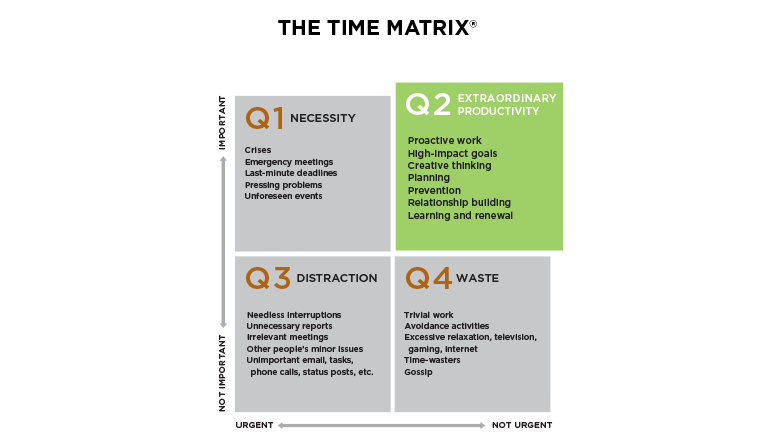
For instance, leaders who take Choice 1: Act on the Important, Don’t React to the Urgent® to heart are able to prioritize high-value outcomes, even when seemingly urgent distractions come into the mix. The Time Matrix® below can help leaders distinguish between important and urgent tasks, enabling leaders to make better decisions about how to effectively allocate their time.
Time management isn’t a new skill, but leaders can leverage new technologies to assist them in mastering it. In 2026, embracing AI in the workplace will allow leaders to automate routine tasks and focus on strategic decision-making. AI-driven tools can streamline operations and enhance clarity in project management, making it easier for leaders to maintain focus on high-impact work.
Strategies:
- Leverage AI When Appropriate: AI is increasingly becoming a valuable tool in leadership, allowing leaders to automate routine tasks and focus on higher-value work. Leveraging AI for work and administrative tasks, such as scheduling, data analysis, or communication management, helps leaders reclaim valuable time for strategic thinking and decision-making. Leaders who embrace AI-driven tools can improve productivity and free up their time for more impactful work.
- Make Room for the Big Rocks: Outlined in Choice 3: Schedule the Big Rocks, Don’t Sort Gravel®, leaders must learn to prioritize the most important tasks—the “big rocks”—and allocate time for them before anything else. By putting your most significant responsibilities at the top of your to-do list, you ensure that key priorities are never sidelined by minor distractions. This choice helps leaders create a disciplined, results-driven approach to their schedules.
- Be Mindful With Emerging Technology: Technology can be a huge asset when used intentionally, but it can also be a source of constant distraction. Choice 4: Rule Your Technology, Don’t Let It Rule You® emphasizes the importance of setting boundaries with technology, such as managing notifications and limiting time spent on digital devices, so that leaders can remain focused on their most important tasks. Leaders who can take control of their technology will be better able to stay on track and maintain focus throughout the day.
- Remember to Recharge: Leaders often face the risk of burnout due to the demands of their role. Choice 5: Fuel Your Fire, Don’t Burn Out® encourages leaders to focus on their own well-being by setting aside time for rest, recovery, and activities that recharge them. By maintaining energy and avoiding burnout, leaders can sustain their performance and effectiveness over the long term.
By integrating these choices into their daily routines, leaders can not only improve their time management but also ensure that they are leading with clarity, focus, and intention.
Organize your workload effectively and achieve your top priorities in 2026 when you download our guide, Manage Your Time Like a Pro: 7 Tips For Doing What Matters Most.
2. Strengthen Trust-Building Interpersonal Skills

The first job of a leader at work or at home is to inspire trust. It’s to bring out the best in people by entrusting them with meaningful stewardships, and to create an environment in which high-trust interaction inspires creativity and possibility.
While technical skills are often thought of as a prerequisite for leadership promotions, human skills are just as important, if not more important, for effective leadership outcomes. The ability to listen actively, show empathy, and manage relationships effectively is vital to fostering engagement and trust within teams.
Despite a recent drop in employee engagement, with only 31% of U.S. employees reporting that they are engaged at work in a recent Gallup survey, leaders can play a key role in improving engagement through the use of soft skills. These skills are crucial for interpreting data with context, managing uncertainty, and creating trust.
Strategies:
- Request feedback to uncover interpersonal blind spots: Feedback is one of the most powerful tools for improving interpersonal skills. Leaders should actively seek feedback from their teams, peers, and mentors to uncover areas where they might not be aware of their impact on others. Asking questions like, “How can I improve the way I communicate?” or “Are there ways I can be more supportive to the team?” will help leaders identify areas for growth. Regularly requesting feedback helps leaders stay grounded and avoid blind spots that could hinder relationship-building and team cohesion. Additionally, incorporating feedback into their daily actions demonstrates vulnerability and a growth mindset—both of which foster trust and show that leaders are invested in their own development.
- Practice active listening and empathy: Active listening is the foundation of building strong relationships. Leaders who practice active listening demonstrate a genuine interest in understanding their team members’ perspectives, which fosters trust and collaboration. This requires not only hearing what is said but also interpreting nonverbal cues, such as body language and tone of voice, to fully grasp the message. In practice, this means avoiding distractions, maintaining eye contact, and reflecting back what has been said to ensure understanding. By showing empathy and listening with the intent to understand before responding, leaders can connect with their teams on a deeper level and create a supportive environment that builds rapport, reduces conflict, and increases mutual respect—ensuring that all voices are heard and valued.
- Engage in regular reflection: In addition to feedback and listening, leaders should regularly reflect on their interactions with team members. This could involve taking time at the end of each week to review key conversations, decisions, and interactions. Reflecting on what went well and where there is room for improvement helps leaders stay conscious of their behaviors and adjust accordingly. This practice not only strengthens emotional intelligence but also enhances self-awareness, a key component of interpersonal effectiveness.
As leaders continue to cultivate interpersonal skills, they will be better prepared to lead through times of uncertainty, maintaining a motivated and engaged team while building trust.
Learn to lead with humanity and strengthen team connections with our guide, 6 Key Communication Phrases to Build Trust and Inspire Your Team.
3. Lead Through Change With Intention
A plan gives both leaders and teams a path forward in times of change.
Change is inevitable, but it is how leaders guide their teams through it that determines success. Leaders must be adaptable, resilient, and able to maintain team morale during disruptions. By embracing a solution-oriented mindset, leaders can help transform challenging periods of uncertainty into new opportunities. A leader’s ability to stay calm, focused, and optimistic during times of change inspires confidence and drives the team toward success.
When individuals can lead through change with intention, they help their teams stay aligned, maintain agility, and keep moving forward even when the road ahead is unclear. In a fast-paced, ever-evolving work environment, leaders who model flexibility and openness are better equipped to guide their teams through uncertainty while ensuring high performance and engagement.
Strategies:
- Communicate transparently: One of the most important ways to lead through change is by communicating openly and honestly with your team. Leaders should share information about upcoming changes as early as possible, offering clarity on what will be different and why the change is necessary. Transparency helps reduce anxiety and prevents misinformation from spreading, fostering a sense of trust and ensuring that team members feel prepared for what’s to come. By addressing concerns and providing a clear narrative, leaders can help their teams feel more confident and aligned in the face of change.
- Start small: When faced with significant change, leaders can help their teams manage the process more effectively by breaking larger changes down into smaller, more achievable steps. This makes the change feel less overwhelming and creates a clear roadmap for success. Additionally, leaders who set clear milestones and celebrate small wins along the way will build momentum and reinforce progress. Recognizing incremental achievements boosts morale and helps maintain motivation, even when the final goal feels distant. Celebrating small wins also helps teams feel a sense of accomplishment and reinforces that change is a process that can be successfully navigated.
- Create a safe environment to fail: During times of change, it’s crucial for leaders to encourage innovation and learning. Change often requires teams to adopt new ways of thinking and working, so leaders should create a culture that embraces experimentation and allows for mistakes. By normalizing failure as part of the learning process, rather than allowing stigma and fear to impede innovation, leaders can foster creativity and risk-taking to ultimately drive growth and improvement. Encouraging a “fail fast, learn quickly” mindset enables teams to adapt to change more rapidly and build resilience in the face of setbacks.
Discover what’s driving today’s biggest disruptions for your workforce and the leadership behaviors that drive engagement and performance in our guide, The Energy of Change.
4. Delegate With Purpose and Confidence
Effective delegation strengthens team capabilities, fosters trust, and prevents burnout. Leaders who empower their teams to take ownership of tasks help build a sense of responsibility and enhance overall team performance. Extending trust is a crucial part of this process; when leaders delegate thoughtfully, they build organizational trust that fuels collaboration and growth.
Strategies:
- Match tasks to existing skillsets: Leaders should be strategic in identifying tasks that can be delegated to others. This requires a deep understanding of the team’s strengths, development goals, and areas of expertise. By matching the right tasks to the right team members, leaders ensure that their teams are operating at their highest potential. Empowering team members to own important tasks boosts their confidence and provides opportunities for them to develop their skills.
- Provide clear expectations: To set team members up for success, leaders must provide clear expectations about what needs to be done, how it should be done, and why it’s important. Clear communication helps to eliminate confusion and ensures that everyone is aligned on the goal and the desired outcome. Providing context around the task helps team members understand how their work contributes to the bigger picture, which reinforces a sense of purpose and accountability.
- Resist the urge to micromanage: Micromanagement undermines trust and stifles creativity. Leaders must resist the temptation to control every aspect of a team member’s work and instead empower them to take ownership of their tasks. Giving team members the freedom to approach challenges in their own way fosters independence and builds their confidence. When leaders trust their teams to lead and make decisions, it creates a culture of empowerment and mutual respect.
- Follow up to ensure accountability: While delegation involves trusting others to take ownership of tasks, it’s also essential for leaders to foster accountability. Scheduling regular check-ins, team meetings, or progress reviews will ensure that tasks are on track and that team members have the support they need. Following up at agreed intervals also reinforces the leader’s commitment to their team and helps maintain momentum, ensuring that tasks are completed successfully and on time. Accountability encourages responsibility and aligns team efforts with organizational goals.
Foster accountability and inspire your team to achieve outstanding outcomes with our guide, 8 Ways to Boost Your Team’s Commitment to Goals.
5. Communicate With Greater Clarity and Impact
Whether leading a team meeting, presenting to senior stakeholders, or writing a project update, leaders must convey ideas in a way that aligns people, drives action, and builds trust. Miscommunication can result in missed opportunities, delayed decisions, and confusion about priorities. In contrast, leaders who communicate with precision and purpose strengthen collaboration and accelerate execution.
Remember: Your brilliant vision is only as strong as your ability to communicate it. An effective communication framework like Writing For Results™ can help leaders craft messages that are structured, relevant, and audience-focused. These tools equip leaders to cut through complexity, connect with a wide variety of groups , and deliver messages that inspire confidence and clarity.
Strategies:
- Practice structured messaging: Strong communicators organize their thoughts before speaking or writing. Using a simple structure—such as problem, solution, and action—helps ensure messages are clear and actionable. Whether you’re delivering feedback or pitching a new idea, starting with the “why” and ending with a call to action keeps conversations on track.
- Record and review communication for tone and clarity: Leaders can improve by listening to recordings of their presentations or meetings or have a trusted colleague review an email before it’s sent. This practice reveals filler words, vague phrases, or inconsistent tone. By reflecting on real examples, leaders become more intentional about how they show up in communication moments.
- Tailor communication to your audience: Great communicators adjust their approach based on who they’re speaking to. What resonates with executives might not be the same as what’s effective for frontline team members. Consider the audience’s priorities, language, and level of context needed. This practice shows respect for others’ time and enhances engagement.
- Invest in writing skills: In today’s digital workplace, written communication is more critical than ever. Leaders should refine their ability to write clear, concise, and persuasive messages that cut through digital clutter. While AI can provide a great starting point, it’s not a substitute for human connection and the unique point of view that each leader brings to the table.
By improving communication discipline and practicing message clarity, leaders can increase alignment, build stronger relationships, and accelerate performance across teams and stakeholders.
Download our guide, From Misunderstood to Magnetic: A Leader’s Guide to Clear Communication, to learn how great leaders can hone their skills and ensure their message lands.
6. Develop Future Leaders Through Mentorship
One of the most impactful ways to build a strong leadership bench is through intentional mentorship. By creating a culture of coaching, leaders set in motion a ripple effect of capability and confidence across the organization. Effective mentorship doesn’t merely support individual development; it also reinforces your organization’s identity as one that values learning, accountability, and long-term succession planning.
When leaders become mentors and consciously develop ongoing opportunities for learning, they help emerging leaders accelerate their development and better contribute to organizational goals.
Strategies:
- Schedule regular coaching conversations: Consistency matters in mentorship. Establishing a regular cadence—monthly check-ins or biweekly touchpoints—helps mentees stay focused on their goals while giving mentors a platform to provide timely feedback. These conversations don’t need to be long, but they should be intentional and anchored in growth.
- Support goal setting and reflection: A powerful mentorship relationship includes helping mentees define clear, measurable development goals. Encouraging them to reflect on their progress builds self-awareness and resilience. Leaders should ask thought-provoking questions like, “What challenges are helping you grow the most?” or “Where do you want to stretch next?”
- Assign stretch opportunities: Practical experience is often the most effective teacher. Assigning mentees to lead a project, present to leadership, or navigate a cross-functional initiative gives them hands-on exposure to real challenges. These stretch assignments push them out of their comfort zones and develop both competence and confidence.
- Model the behaviors you want to see: Mentees learn just as much by observation as they do from direct coaching. Leaders should demonstrate the standards, values, and disciplines they’re encouraging in others. Whether it’s showing how to manage conflict or navigate strategic decisions, modeling is a crucial component of mentorship.
Mentorship is not a one-time event—it’s an ongoing commitment to developing the people who will shape the future of your organization.
Build a resilient leadership playbook for an uncertain future when you download our guide, Where Are All the Great Leaders?
7. Improve Strategic Execution
Focusing on the wildly important requires you to go against your basic wiring as a leader to do more, and instead, focus on less so that your team can achieve more.
Strategic focus is the ability to prioritize what matters most and protect it from distractions. Many leaders are pulled in multiple directions, juggling competing priorities, endless meetings, and the pressure to produce immediate results. Without a clear focus on the most important goals, teams drift, resources are misused, and progress stalls.
An execution framework like The 4 Disciplines of Execution® helps leaders and teams achieve more by focusing on less. When leaders apply strategic focus consistently, they create clarity across the organization and ensure teams are working toward what truly moves the needle. Leaders can repurpose the steps they used to turn their vision into actionable goals to align their teams around their top priorities for 2026.
Strategies:
- Define and commit to a single WIG: Leaders must decide what is most important—and make that priority visible and central to the team’s work. A WIG should be specific, measurable, and tied to high-stakes outcomes. When teams focus on one or two critical goals rather than many, they are more likely to deliver breakthrough results.
- Use lead and lag measures to guide focus: Strategic execution requires more than tracking end results. Leaders should identify lead measures—key activities that predict success—and monitor them regularly. This helps teams adjust course early and stay engaged in the behaviors that drive outcomes.
- Implement visual scoreboards to maintain alignment: Teams that see progress stay motivated. Using simple, visible scoreboards allows teams to track performance in real time, reinforcing ownership and commitment. Scoreboards should be easy to understand and updated frequently to reflect current performance.
- Maintain a cadence of accountability: Weekly team check-ins focused on commitments and progress help keep strategic goals top of mind. These sessions should be short, focused, and disciplined—each team member reports on past commitments, reviews the scoreboard, and makes a new commitment for the week.
Leaders who practice strategic focus bring clarity to complexity. By prioritizing what matters most and executing with discipline, they unlock higher levels of performance and alignment throughout their teams.
Download our guide, Execute Your Strategic Goals and Create Breakthrough Results, and set the stage for a high-performance culture that consistently inspires teams to achieve more.
8. Strengthen Team Alignment
Team alignment is essential to achieving consistent, high-quality results. When teams are aligned around shared goals, expectations, and roles, they make better decisions, collaborate more effectively, and deliver greater impact. However, FranklinCovey research shows that only 15% of employees can name their organization’s most important goals—revealing a significant disconnect between strategy and execution.
Leaders play a pivotal role in fostering team development and alignment. By clearly articulating goals, creating shared understanding, and reinforcing accountability, they ensure that every team member is working toward the same outcomes.
Strategies:
- Regularly clarify priorities and expectations: Clarity must be reinforced, especially in dynamic environments where priorities frequently shift. Leaders should take time during team meetings or project launches to review key goals and ensure each person understands their role in achieving them. Don’t assume alignment; make it explicit by asking questions, checking for understanding, and connecting the dots.
- Use team kickoffs and briefs to establish shared ownership: At the beginning of projects or strategic initiatives, leaders should host structured kickoff sessions. These sessions clarify objectives, roles, success measures, and timelines. When everyone starts with the same understanding, teams can execute with speed and accuracy.
- Establish shared language and decision-making criteria: Alignment improves when teams use a common framework for decision-making. Whether it’s evaluating trade-offs or agreeing on criteria for prioritizing tasks, a shared language and established processes for making decisions will accelerate alignment and reduce friction.
- Reinforce alignment through regular feedback and course correction: As work progresses, leaders should review whether efforts are still aligned with goals and make real-time adjustments. Feedback loops, both formal and informal, will help teams stay agile and stay focused on what matters most.
Alignment isn’t a one-time event—it’s an ongoing leadership discipline. When leaders create an environment of alignment, they empower teams to move faster with greater confidence. This alignment drives consistency, improves execution, and ensures that individual contributions ladder up to enterprise-wide success.
In a rapidly shifting workplace, ensure your teams are aligned and inspired to achieve your top initiatives when you download our guide, Mobilize Your Team to Deliver Breakthrough Results.
Advance Your Leadership Through Focused Goals
Leadership growth doesn’t happen immediately, nor is it a one-time event. Instead, it’s a continuous journey that requires consistent practice, reflection, and intentional goal setting. By focusing on these critical leadership goals, leaders can begin 2026 by cultivating the skills needed to drive team engagement, performance, and long-term organizational success.
Effective leadership directly impacts trust, engagement, and performance. Leaders should assess their strengths, role expectations, and team needs when selecting the goals they wish to pursue. By choosing a few goals to focus on at a time, leaders can make meaningful, sustainable progress. Learn how partnering with FranklinCovey to develop your leaders and create a framework for strategic execution can inspire your teams to deliver exceptional results.