









How to Build Trust in the Workplace: 5 Actionable Strategies

- The Foundation of Trust: Why Trust Matters in the Workplace
- 5 Actionable Strategies: How to Build Trust in the Workplace
- Lead by Example With Integrity and Consistency
- Communicate Openly and Transparently
- Demonstrate Competence and Accountability
- Foster Respect to Build Positive Relationships
- Empower and Support Your Team
- The Ripple Effect: How Trust Transforms the Workplace
- Build Trust to Unleash Greatness in Others
Key Takeaways:
- Leaders build trust by demonstrating integrity, consistency, and competence through their actions and results.
- Clear communication and active listening strengthen relationships and reduce friction across teams.
- Empowering team members with ownership, accountability, and development opportunities creates durable trust that scales across the organization.
According to Gallup, only 19% of U.S. employees strongly agree they trust their organization’s leadership. This reveals a critical trust gap that leaders cannot afford to ignore.
Trust isn’t a “nice-to-have.” It’s an essential and measurable performance driver. When trust is low, teams slow down, collaboration breaks down, and execution suffers. But when trust is high, communication accelerates, accountability strengthens, and people bring greater energy and ownership to their work.
Trust directly influences employee engagement, decision quality, innovation, and retention. It determines whether people simply comply or truly commit. Great leaders understand that trust is built intentionally—through daily behaviors, consistent execution, and a clear commitment to doing what is right.
The Foundation of Trust: Why Trust Matters in the Workplace

Extending trust is the ultimate act of leadership, the defining skill that transforms a manager into a leader.
Trust is one of the most valuable currencies in any organization. It determines the speed at which work gets done—and the cost at which it happens.
High trust reduces friction. Decisions are made faster. Conversations are more direct. Teams collaborate more openly. We call these gains “trust dividends.” Low trust, on the other hand, creates costly drag with its layers of approval, second-guessing, and disengagement—outcomes we refer to as “trust taxes.”
Strong organizational trust enables leaders to align people around shared goals while empowering them to act with confidence. When leaders and teams actively build trust, people assume positive intent, share information freely, and work through challenges constructively rather than defensively.
Trust also enables collaborative communication, where ideas are exchanged openly, various viewpoints are considered, and teams solve problems together instead of protecting silos.
FranklinCovey research shows that trust is built at the intersection of character and competence:
- Character reflects integrity, intent, and consistency.
- Competence reflects capabilities, execution, and results.
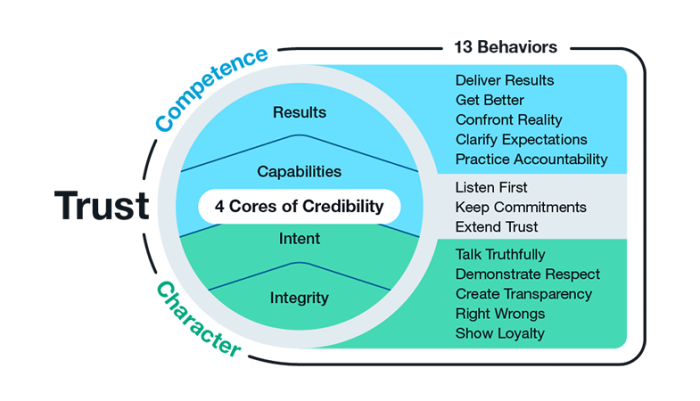
Both components are required. Leaders who have strong character but fail to deliver results lose credibility. Leaders who deliver results but lack integrity erode confidence. Sustainable trust is built when leaders consistently demonstrate both.
Discover how great leaders engage their teams and drive performance amid uncertainty when you download our guide, Trust & Inspire®: The Leadership Framework Built for Disruption.
5 Actionable Strategies: How to Build Trust in the Workplace
The first job of a leader at work or at home is to inspire trust. It’s to bring out the best in people by entrusting them with meaningful stewardships, and to create an environment in which high-trust interaction inspires creativity and possibility.
1. Lead by Example With Integrity and Consistency
As a leader, your character matters. Leaders set the tone for trust through how they behave when expectations are clear—and especially when they are not.
When demonstrating integrity, impact matters more than intent. Leaders build trust when their actions consistently align with their stated values, priorities, and commitments. When leaders say one thing and do another, trust erodes quickly.
One of the most powerful trust-building disciplines is personal accountability. Leaders who take ownership of outcomes, rather than deflecting responsibility, create an environment where others feel safe to do the same.
Being proactive means taking responsibility for one’s choices, behaviors, and results. Proactive leaders don’t blame circumstances or other people. Instead, they focus on what they can control and act with intention.
How leaders build trust through integrity and consistency:
- They keep commitments, even when it’s inconvenient.
- They acknowledge mistakes openly and correct course quickly.
- They apply standards fairly and consistently.
- They make decisions grounded in principles, not pressure.
Actionable steps leaders can take immediately:
- Identify commitments you’ve made to your team and assess where you can improve your follow-through.
- Clarify expectations before making promises to avoid overcommitting.
- Publicly acknowledge when priorities change and explain why.
- Model accountability by owning outcomes, especially when results fall short.
When leaders lead with integrity, trust becomes the default—not the exception.
Download our guide, 7 Steps to Create an Environment of Trust on Your Teams, to learn how great leaders model and extend trust to unleash the potential of their people.
2. Communicate Openly and Transparently
Trust thrives in environments where communication is clear, consistent, and honest. When leaders withhold information, avoid difficult conversations, or communicate inconsistently, uncertainty fills the gap and trust diminishes.
Open communication doesn’t mean you need to share everything. But it does mean you should share what matters, when it matters, and explain the reasoning behind decisions whenever possible. Transparency builds confidence, even when the message is challenging.
Respect is demonstrated most clearly through active listening. Leaders must listen with the intent to understand rather than to respond or persuade. When people feel understood, trust increases—even if they don’t immediately agree with your point of view or the decision being made. Leaders who practice listening to understand—not to control—create environments where people are willing to speak up, share ideas, and engage fully.
Great leaders also create structured opportunities for dialogue. Ensuring your regular 1-on-1 meetings serve not as status updates, but as meaningful conversations focused on priorities, progress, and development helps to establish open and transparent communication.
Trust-building communication practices include:
- Clarifying expectations early and often.
- Explaining the “why” behind decisions.
- Inviting questions and addressing concerns directly.
- Listening without defensiveness or interruption.
Actionable steps leaders can take immediately:
- Schedule consistent 1‑on‑1s and protect that time from distractions and cancellations.
- Start conversations by asking open-ended questions before sharing your perspective.
- Summarize what you’ve heard to ensure understanding.
- Close conversations with clarity on next steps and expectations.
When leaders communicate with openness and discipline, uncertainty is replaced with clarity—resulting in increased trust and engagement.
Build trust through improved communication when you download our guide, Listen Like a Leader: 9 Tips to Drive Powerful Conversations.
3. Demonstrate Competence and Accountability
Trust is reinforced when leaders consistently deliver results. Competence signals reliability. When leaders follow through on commitments and execute effectively, teams gain confidence in both leadership and the direction of their work.
Gallup reports that only 31% of U.S. employees are engaged, highlighting a strong connection between low engagement, weak execution, and diminished trust.
Leaders strengthen trust by ensuring clarity around goals, roles, and performance expectations. Without this clarity, even capable teams struggle to execute effectively. Regular accountability practices ensure commitments are visible, progress is tracked, and obstacles are addressed early.
How competence builds trust:
- Teams see that leadership priorities are real, not theoretical.
- Expectations are clear and measurable.
- Progress is reviewed consistently, not sporadically.
- Successes and gaps are addressed constructively.
Actionable steps leaders can take immediately:
- Identify the most important outcomes your team must deliver.
- Establish clear measures of success and ownership.
- Hold weekly or biweekly accountability conversations focused on commitments.
- Recognize progress and course-correct quickly when execution slips.
When leaders demonstrate competence through disciplined execution, trust is reinforced through results—not words alone.
Download our guide, Mobilize Your Team to Deliver Breakthrough Results, to align your people around clear priorities and a proven execution framework that builds trust and accountability.
4. Foster Respect to Build Positive Relationships
Trust is sustained through relationships grounded in respect. Leaders build respect by valuing others’ perspectives, acknowledging contributions, and treating people with fairness and dignity—especially when giving or receiving feedback.
Leaders can create a culture of feedback when coaching and critiques are timely, specific, and focused on growth rather than blame. It’s essential to maintain a healthy balance of courage and consideration; the leaders who successfully strike this balance will address challenges head-on and engage their teams. Feedback, when delivered respectfully, strengthens trust rather than undermining it.
Trust-building relationship practices include:
- Inviting various perspectives during decision-making
- Acknowledging effort as well as outcomes
- Addressing issues directly rather than indirectly
- Accepting feedback with grace instead of defensiveness
- Separating the person from the problem
Actionable steps leaders can take immediately:
- Ask for input before finalizing decisions that affect the team.
- Provide feedback regularly, not just during formal reviews.
- Address conflict early, constructively, and privately.
- Publicly recognize contributions that align with team values.
When leaders lead with respect and provide feedback in ways that “call in” rather than “call out,” trust becomes embedded in everyday interactions.
Reveal how trust, accountability, agility, and feedback drive performance and engagement when you download our guide, The 4 Pillars of a Thriving Workplace Culture.
5. Empower and Support Your Team
Trust deepens when leaders empower others with ownership and responsibility. Empowerment signals confidence. It tells people, “I trust your judgment and I trust your ability to deliver.”
Empowered teams move faster, solve problems proactively, and take greater pride in their work. However, empowerment without clarity creates confusion. Great leaders must balance autonomy with clear expectations and accountability.
Building trust through empowerment also requires investing in people’s growth. Leaders who prioritize development demonstrate long-term commitment to their teams’ success.
Leaders can also strengthen ownership by fostering accountability in the workplace and building capability through team development.
Trust-building empowerment practices include:
- Delegating outcomes, not just tasks
- Providing resources and support without micromanaging
- Encouraging learning through challenges and stretch opportunities
- Holding people accountable with fairness and clarity
Actionable steps leaders can take immediately:
- Identify which decisions can be owned by the team.
- Clarify success criteria and guardrails upfront.
- Offer coaching support instead of taking control.
- Invest in learning opportunities that build confidence and capability.
When leaders empower others intentionally, trust scales beyond individual relationships and becomes part of the culture.
Sidestep the practices that often erode trust and discourage teams when you download our guide, 6 Ways Your Leaders Can Build Trust and Avoid Breaking It.
The Ripple Effect: How Trust Transforms the Workplace
Trust is the highest form of human motivation.
Trust shapes how teams collaborate, how decisions are made, and how organizations respond to change, disruption, and transformation. It’s the great difference maker that enables cultures to thrive, even amid uncertainty. Great Place to Work reports that high-trust organizations consistently exhibit stronger financial performance and stability amid disruption, as well as lower rates of turnover, compared to organizations with lower-trust cultures.
When leaders consistently build trust, the impact extends beyond relationships to workplace performance. High-trust cultures are more agile and resilient. They reduce friction and help teams maintain momentum during change. Research reported by Harvard Business Review shows that people in high-trust organizations experience 50% higher productivity, 76% greater engagement, and more than double the energy at work than those in low-trust organizations. Trust is also foundational to effective change leadership. When trust is present, people are more willing to move forward together—even when conditions are ambiguous.
Trust in teams and leadership creates a high-performance culture where people feel supported, accountable for results, and engaged for the long-term. Gallup reports that employees who trust their leaders are 61% more likely to stay with their organization. In short, trust is a driver of engagement, retention, and long-term success.
Build Trust to Unleash Greatness in Others
Trust is the catalyst that unlocks potential. It enables people to take initiative, contribute ideas, and bring their best effort to the work that matters most.
Leaders who build trust create environments where greatness can be unleashed. Rather than relying on control or compliance, they lead with clarity, character, and conviction—inviting their teams to rise to the challenge.
By communicating openly, executing with discipline, modeling integrity, and empowering others, leaders foster a culture where individuals feel trusted and become inspired to perform at their highest level.
The future of work relies on leaders to move beyond traditional Command & Control models. Explore how the Trust & Inspire framework can equip your leaders with the mindset and skills to lead with trust, elevate performance, and unleash the full potential of their teams.