










10 Work Goal Examples for Successful Leaders

Key Takeaways
- Effective leaders set clear, measurable goals to drive team performance, engagement, and continuous improvement.
- Skill‑based, professional development, and performance goals help leaders model behaviors they expect from their teams.
- Strong goal‑setting habits support clarity, accountability, and sustainable results over time.
Why Setting Work Goals Matters for Leaders
Work goals are clear, measurable objectives that align intentions with outcomes. For leaders, setting and modeling such goals establishes a roadmap of what matters, creates shared focus, and anchors daily efforts. When leaders own their goals publicly, teams gain clarity on priorities, understand how success will be measured, and can align their efforts accordingly.
This alignment becomes even more critical in 2026, as organizations navigate shifting business environments, evolving technologies, and changing workforce expectations. Leaders who establish firm yet flexible goals build the foundation for consistent execution, resilience, and performance throughout the year.
How Leaders Can Set Effective Work Goals
Strong goals for leaders are focused, measurable, and designed for execution. Here’s how to build them with clarity and impact:
1. Focus on the Wildly Important

Focusing on the wildly important requires you to go against your basic wiring as a leader to do more, and instead, focus on less so that your team can achieve more.
Leaders juggle countless priorities, but not all goals deserve equal attention. Identify one Wildly Important Goal® (WIG®) that, if achieved, would make the biggest difference.
WIGs are high-stakes, high-impact objectives that wouldn’t otherwise be achieved without deliberate focus and sustained effort. They should be clear, specific, and follow the “From X to Y by When” format to track meaningful progress.
Examples of WIGs include:
- Increase qualified pipeline opportunities from $3.5M to $5.5M by the end of the fiscal year.
- Reduce average order fulfillment time from 10 days to 6 days by the end of Q2.
Identifying your WIG and ensuring you have an execution framework to achieve it can turn rote New Year’s resolutions into major progress in your role and for your organization.
Download our interactive workbook to clarify top priorities and follow a simple formula to achieve your top priorities: 4 Steps to Refine and Execute Your Team Goals
2. Invest Time Where It Matters
The most effective leaders don’t just manage their time—they invest it wisely. Put key priorities first by using tools or referencing charts like the Four Quadrants of Time Management. Dividing work into these quadrants helps leaders distinguish between what feels urgent and what is truly important.
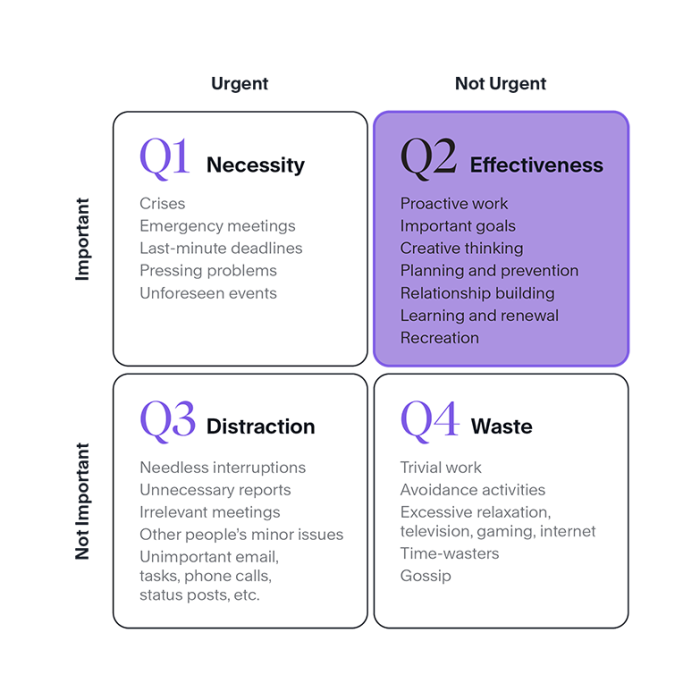
Too often, the whirlwind of daily tasks pulls leaders into Quadrant 1 (urgent and important) or even Quadrant 3 (urgent but not important) activities. But long-term impact comes from consistently operating in Quadrant 2, where leaders focus on tasks that are important but not urgent. This is where strategic thinking, planning, coaching, innovation, and team development live. These are the activities that don’t demand your attention today but determine your results tomorrow.
Making space for Quadrant 2 work requires intentional planning and the discipline to protect time from distraction. Leaders who do this create the clarity, capacity, and focus needed to lead at a higher level.
Become a master of time management and achieve your top priorities when you download our guide, Manage Your Time Like a Pro: 7 Tips for Doing What Matters Most.
3. Execute with Consistency
Great goals require a consistent rhythm of follow-through. The most effective leaders build a cadence of accountability by setting aside time each week to review progress, report on commitments, and realign focus.
This weekly rhythm ensures that priorities don’t get lost in the whirlwind. It creates space for reflection, reinforces ownership, and allows for timely course corrections—all critical to sustaining momentum. With a consistent cadence to check in on progress, leaders turn goals into habits, and habits into results.
Create a winnable game and set yourself up for success in 2026 with our guide, Execute Your Strategic Goals and Create Breakthrough Results.
4. Make Progress Visible
When progress is visible, motivation increases, focus sharpens, and accountability grows. That’s why leaders should create a visible and compelling scoreboard to make goal progress obvious—not buried in spreadsheets or saved for quarterly reviews.
Whether you use a shared digital dashboard or a physical team scoreboard, the goal is the same: to help everyone immediately see whether they’re winning or falling behind. This kind of visual tracking reinforces lead measures, sparks problem-solving, and keeps the team aligned around outcomes that matter.
Visibility also builds momentum. When people can see their efforts moving the needle, even in small increments, they stay engaged. And when things stall, the data provides a clear signal to adjust.
10 Work Goal Examples for Successful Leaders in 2026
Below are 10 goal examples for leaders, grouped into three categories. Each includes a brief explanation and a practical example that could apply in 2026’s fast‑changing environment.
Skill-Based Work Goals
Skill-based goals help leaders strengthen the foundational capabilities that drive influence, execution, and trust. This will prove especially vital as 2026 brings new technologies, changing team dynamics, and increased complexity.
1. Improve Team Communication
Strong communication is the backbone of effective leadership. It creates the clarity teams need to execute, the trust required to collaborate, and the alignment necessary to meet shared goals. In 2026, many teams continue to navigate hybrid schedules, cross-functional projects, and increasingly fast-paced decision-making. Without intentional communication, priorities become unclear, engagement drops, and execution suffers.
Leaders need to set specific goals that go beyond “communicate more.” Rather, leaders should focus on building specific behaviors into the rhythm of team life. This could include implementing structured weekly updates, applying targeted communication strategies, facilitating open-ended feedback sessions, or taking a targeted communication course that reinforces key messaging and listening techniques.
Strong communication habits also prevent avoidable rework, improve psychological readiness for change, and create a more accountable and connected culture. For example, adjusting meeting cadence and clarity may directly reduce time spent resolving misunderstandings or chasing incomplete updates.
Example:
Improve team communication clarity and alignment by increasing team satisfaction scores from 72% to 85% within 12 weeks.
Ensure your message resonates when you download our guide, How Leaders Can Communicate With Impact.
2. Lead Effective AI Adoption
AI is consistently reshaping how teams handle analysis, reporting, customer interactions, and even creative problem-solving. Yet, while 88% of organizations are using AI at work, only 28% have positioned their people to achieve transformative business impact from it. This gap highlights a growing leadership challenge: Adoption alone isn’t enough—success hinges on how effectively leaders guide their teams through implementation.
In 2026, the difference between teams that thrive and those that stall will depend on whether leaders set clear, actionable goals for AI adoption. These goals should build team competence and confidence, starting with identifying high-impact workflows—such as forecasting, knowledge retrieval, or process automation—where AI can measurably improve performance.
Leaders must also ensure AI is introduced responsibly, with proper oversight and alignment to strategic priorities. When adoption is led effectively, the benefits extend beyond efficiency. Teams can offload repetitive work and reinvest their time in more strategic, creative, or collaborative efforts, increasing both output and morale.
Strong goals in this area might focus on piloting tools in defined use cases, fostering shared learning across the team, or creating feedback loops to assess and adjust implementation. Ultimately, leaders are pivotal for creating space for teams to embrace AI in the workplace in ways that are both strategic and aligned with core business priorities.
Example:
Enhance team productivity by implementing AI into two high-impact workflows and achieving 30% time savings by the end of the quarter.
Download our guide, The Human + AI Partnership, to speed AI adoption by leveraging the strengths of your team.
3. Refine Coaching Skills
Effective leaders don’t just direct—they develop others. Coaching is a critical leadership skill that drives growth, alignment, and long-term engagement. When approached with intention, coaching helps individuals take ownership of their performance, navigate challenges, and pursue meaningful development paths.
Regular 1-on-1 conversations are one of the most important tools in a leader’s coaching toolkit. But to be effective, they need structure, consistency, and a focus on outcomes. Goals in this area should emphasize regular 1-on-1s, action-based follow-ups, and alignment with each team member’s development goals.
Effective coaching also plays a critical role in gaining buy-in. When people feel seen, heard, and supported, they’re more likely to commit to goals, own their performance, and align with the team’s mission. It helps reduce friction, strengthen collaboration, and create a culture where people are motivated to improve—not just for their leader, but for themselves.
Coaching services can provide tools and frameworks that help leaders strengthen this skill, reinforce consistency, and approach development conversations with clarity and impact.
Example:
Ensure 100% of team members complete a career development course or certification aligned with their growth plans within the next 90 days.
Discover the power of personal coaching in uncertain times when you download our guide, Coaching: Equip Your Leaders to Navigate What’s Next.
4. Build Conflict-Resolution Skills
Most of us don’t enjoy conflict. But it’s often inevitable at work—and when it’s handled well, it becomes a catalyst for growth, alignment, and stronger working relationships. In high-performing teams, conflict isn’t ignored or minimized. It’s surfaced early, addressed directly, and resolved in ways that preserve trust and move the team forward.
Leaders play a central role in modeling this approach. Avoidance, ambiguity, or reactive behavior can quickly erode team culture. On the other hand, leaders who set clear goals around developing conflict-resolution skills help create an environment of clarity, candor, and mutual respect.
This begins with learning to recognize the difference between healthy tension and damaging friction. It also requires leaders to rebuild trust and credibility when it’s strained, and practicing navigating difficult conversations to approach sensitive issues with clarity and composure.
Leaders who invest in this skill are better equipped to defuse emotional tension, maintain momentum on critical initiatives, and help their teams stay focused on shared outcomes. Over time, this builds a culture where feedback is welcomed, concerns are addressed early, and collaboration becomes more resilient—especially under pressure.
Example:
Facilitate a conflict-resolution mini-workshop or peer learning session within 30 days of completing formal training to reinforce skills across the team.
Learn to handle conflict effectively and build stronger team relationships with our guide, Navigating Difficult Conversations: 4 Strategies to Tackle Tension With Confidence.
Professional Development Work Goals
These goals help leaders expand their perspective, build new capabilities, and prepare their teams and organizations for what’s next.
5. Complete a Leadership Development Program
Leadership requires more than technical competence—it also demands self-awareness, adaptability, and the ability to lead others through uncertainty and change. Structured development programs offer leaders the space to learn and apply high-impact practices that sharpen execution and build trust.
By participating in a formal leadership development program, leaders can refine strategic thinking, improve decision-making, and build greater confidence in leading teams through complex challenges. The most effective programs are grounded in real-world application—ensuring that new ideas don’t stay theoretical but translate into meaningful behavior change.
Whether it’s improving how you delegate, making faster and clearer decisions, or increasing the frequency and quality of feedback, development programs help turn leadership into a repeatable skill set.
Example:
Complete a certified leadership development program and apply three new leadership practices on the job within 12 weeks.
Build a leadership playbook to future-proof your organization with our guide, Where Are All the Great Leaders? Solving the Leadership Crisis in a Disruptive World.
6. Enhance Meeting Effectiveness
The average executive spends a staggering 23 hours per week in meetings, while the average employee attends 62 meetings per month. Although face time can improve collaboration, communication, and innovation, not all meetings are created equal; only 11% of meetings can be considered productive, with 71% of senior managers believing meetings to be inefficient.
Leaders can improve meeting effectiveness by being intentional about purpose, structure, and outcomes. Every meeting should have a clear objective—such as making a decision, solving a problem, or aligning the team—communicated in advance along with a focused agenda.
Whether scheduling a 1-on-1, a weekly team stand-up, or a department-wide call, leaders can model disciplined meeting behavior by starting and ending on time, limiting attendance to essential contributors, and facilitating balanced participation so the right voices are heard. Effective leaders also ensure meetings drive action by summarizing key decisions, clarifying next steps, and assigning action items for others to “own” before the meeting ends. In 1-on-1 meetings, leaders can improve effectiveness and help develop their direct reports by asking thoughtful questions and soliciting feedback about how team members would benefit most from the session.
Over time, consistently well-run meetings build trust, reduce wasted time, and increase team accountability.
Example:
Implement agendas and desired outcomes for all meetings led and increase action item follow-through time by 50% in Q1.
Make the most of your meetings with your team members when you download our guide, 100+ Questions for Better 1-on-1s With Your Direct Reports.
7. Develop Cross‑Functional Collaboration
No leader operates in a vacuum. Strong performance depends on effective coordination across departments, especially in matrixed or fast-moving organizations. When cross-functional collaboration breaks down, so does execution.
Setting goals to develop deeper collaboration skills strengthens relationships across teams and improves the speed and quality of shared work. Leaders can do this by learning what it takes to build an effective cross-functional team and applying proven team collaboration strategies to improve workflows, accountability, and handoffs.
Engaging in department-shadowing, co-leading initiatives, or launching cross-functional task forces are all high-value ways to increase understanding and alignment.
Example:
Strengthen cross-functional alignment by completing four department shadowing sessions and launching one shared improvement initiative within 12 weeks.
Improve collaboration and reduce misinformation with our guide, From Misunderstood to Magnetic: A Leader’s Guide to Clear Communication.
Performance & Role‑Based Work Goals
These goals tie leadership directly to measurable outcomes, helping teams focus on priorities, improve productivity, and grow engagement.
8. Set Clear Team Performance Objectives
In most organizations, only 15% of the front line can name the most important goals of the team. The further from the top of the organization they are, the lower the clarity.
Too many goals can blur focus. One of the most powerful things a leader can do is define one clear, high-impact objective that drives execution across the team. That’s the value of identifying a WIG—it helps the team prioritize what truly matters and direct their energy toward it.
While OKRs and KPIs are useful, they can lead to scattered attention if not managed well. A WIG forces clarity and helps reduce noise by aligning team effort around a single, measurable outcome.
When leaders set a WIG and support it with systems for tracking and accountability, they create forward motion that lasts beyond a single quarter.
Example:
Establish one Wildly Important Goal for the quarter and increase team performance on that priority from a 60% baseline to 90% completion within 12 weeks.
Bolster team buy-in and motivation with our guide, 8 Ways to Boost Your Team’s Commitment to Goals.
9. Improve Team Productivity Metrics
Leaders are responsible for helping their teams operate as efficiently and strategically as possible. This doesn’t just mean doing more—it means doing what matters most with less friction.
Improving productivity often starts by identifying high-friction workflows or unnecessary admin work that slows teams down. Leaders can apply the principles of organizational performance to remove inefficiencies, simplify tools, and elevate how time is spent across the team.
Whether it’s standardizing templates, reducing duplicate reporting, or leveraging automation, small process improvements can free up time for creativity, strategy, and innovation.
Example:
Increase team productivity by reducing time spent on administrative tasks by 25% within 90 days through improved workflows, automation tools, and standardized templates.
Download our guide, Leading Through Uncertainty: 4 Strategies for Doing More of the Right Things With Less, to empower your teams to focus on what matters most in disruptive times.
10. Raise Employee Engagement Scores
Engagement is more than a metric; it’s the emotional commitment team members bring to their work. High employee engagement leads to stronger collaboration, faster execution, and better retention. Low engagement creates drag across everything.
Leaders can directly influence engagement by building trust, creating psychological safety, and reinforcing a culture of feedback. Regular recognition, real-time coaching, and taking visible action on employee feedback all help improve morale and buy-in.
These actions are especially powerful when they’re consistent and intentional—not just reserved for annual surveys or performance reviews. Over time, they help drive lasting culture change.
Example:
Increase employee engagement scores from 78% to 88% within the next 12 weeks by conducting weekly check-ins, offering real-time recognition, and addressing key feedback themes.
In an era of detachment, fuel the fire when you download our guide, The Art of Employee Engagement: How to Inspire and Reignite Your Teams.
Improve Goal Setting and Execution in 2026 and Beyond
Goal setting is more than a planning exercise. When it’s done with intention and discipline, it shapes how teams operate day to day. In 2026, leaders must balance evolving technologies, shifting priorities, and increased demands. To stay effective, goals should be:
- Clear and measurable: Success and progress are visible.
- Focused: Attention is given to what truly matters, not just what’s urgent.
- Linked to action: Behaviors and workflows are directly tied to outcomes.
- Accountable: Goals are tracked visibly and reviewed regularly.
These habits differentiate leaders who react from those who lead with purpose. Embedding structure, discipline, and clarity into goal setting helps teams stay aligned even as contexts shift.
Ready to sharpen your focus, improve your execution, and turn strategic priorities into measurable outcomes? Learn how the proven framework of The 4 Disciplines of Execution® can help leaders and teams unleash breakthrough results, over and over again.