






The Power of Organizational Trust in Leadership

- What is Organizational Trust?
- Key Components of Organizational Trust
- The 13 Behaviors® of High Trust
- Why Organizational Trust Is Crucial for Organizational Success
- How to Build Organizational Trust
- Overcoming Challenges in Building Organizational Trust
- The Role of Trust During Organizational Transformation
- Increase Your Organizational Trust
In every organization striving for sustained success, one foundation stands out: trust. When teams feel their organization is reliable, fair, and aligned with their own values, their commitment deepens. Organizational trust underpins employee engagement, fuels innovation, and ultimately drives superior outcomes.
Companies that establish high levels of internal trust consistently see gains in productivity, retention, and workplace satisfaction because trust becomes a multiplier of performance—rather than a cost. Contrary to popular belief, trust is not an abstract ideal organizations strive for; it is a tangible, measurable asset.
Key Takeaways:
- Organizational trust is essential for performance: High levels of trust within an organization lead to improved employee engagement, productivity, and innovation, along with lowered turnover.
- Trust is built through leadership actions: Leaders can build trust by demonstrating integrity, competence, reliability, compassion, and consistency.
- Trust fosters a culture of collaboration: When trust is established, employees feel more secure, empowered to contribute, and inspired to work together toward organizational goals.
What is Organizational Trust?
Organizational trust refers to the collective confidence employees have in their leadership, peers, organizational systems, and direction. It is less about individual one‑on‑one trust and more about the shared belief across the workforce that leadership acts with integrity, that capabilities exist and are applied, and that established processes will deliver consistent, predictable outcomes.
This trust emerges when employees believe that the organization and its leaders have genuine motives and intent—and demonstrable competence. That competence includes applicable skills as well as the structures and processes needed to deliver on organizational commitments. In other words, the organization does what it claims to do in its mission and vision—and its leaders behave in ways that align with organizational values so that trust is reciprocal across the organization.
When these conditions are in place, teams move beyond mere compliance or transactional relationships to bring their full efforts, creativity, and collaboration to the table.
Key Components of Organizational Trust

Extending trust is the ultimate act of leadership, the defining skill that transforms a manager into a leader.
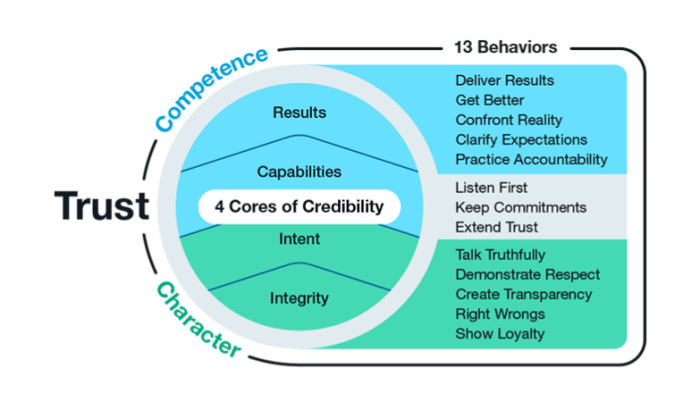
At its essence, organizational trust is built on a blend of who we are and how we perform. More specifically, trust is the result of character and competence working in concert. When both dimensions are present and demonstrated consistently, individuals and teams gain credibility. That credibility, in turn, earns trust throughout the organization.
Character
Character is foundational. Character addresses who we are—our values, motives, and behavior. At its core, character is comprised of two things: intent and integrity. By combining these components of character, leaders can build and extend trust to accelerate engagement and results over time.
- Intent: Does leadership show genuine concern for people, purpose, and shared benefit rather than hidden agendas? Leaders build trust when their intent is rooted in mutual benefit, transparency, and a genuine desire to serve others rather than self-interest.
- Integrity: Are actions aligned with values? Do leaders regularly demonstrate their honesty, consistency, and moral courage? Leaders with integrity are honest, consistent, and willing to do the right thing, even when it’s difficult.
Competence
Competence, the second core dimension, is equally essential, as trust cannot flourish on character alone. Even the most well-intentioned leader will erode trust if they are consistently unable to perform, make informed decisions, or adapt to changing demands. Competence addresses what we do and how well we do it, as seen in their capabilities and results.
- Capabilities: Does the organization possess the requisite talent, skills, knowledge, and resources to perform? Leaders must show that they have the knowledge, skills, and experience necessary to deliver.
- Results: Are commitments fulfilled? Are outcomes delivered? Credibility is grounded in performance—without results, trust cannot endure.
The 13 Behaviors® of High Trust
These four core areas—intent, integrity, capabilities, and results—support a leader’s ability to earn trust, and each one is observable through behavior over time. And while these core areas are the foundation to trust, trust is built and sustained through behavior.
There are 13 Behaviors of High Trust that high-trust leaders consistently model. These behaviors provide a practical framework for turning abstract principles into everyday practices that build trust both quickly and sustainably.
- Talk Straight: Communicate honestly and directly. Avoid spin or misleading language.
- Demonstrate Respect: Treat everyone with fairness and dignity in all interactions.
- Create Transparency: Be open about decisions and the rationale behind them.
- Right Wrongs: Acknowledge mistakes and make things right quickly and visibly.
- Show Loyalty: Speak positively about others, even when they’re not present, and give credit generously.
- Deliver Results: Consistently meet goals and follow through on commitments.
- Get Better: Continuously seek improvement and demonstrate humility by learning.
- Confront Reality: Address issues directly without avoiding conflict or sugarcoating the truth.
- Clarify Expectations: Ensure mutual understanding of roles, goals, and success metrics.
- Practice Accountability: Hold yourself and others responsible for performance and commitments.
- Listen First: Seek to understand before offering opinions or decisions.
- Keep Commitments: Do what you say you’ll do, consistently and reliably.
- Extend Trust: Appropriately give others responsibility and autonomy, signaling confidence in their capabilities.
Together, these 13 behaviors translate the core elements of trust into visible, teachable actions. They are not merely leadership traits—they are habits, practiced daily, that create and reinforce trust within teams and across organizations.
Leadership happens one conversation at a time. Download our guide, 6 Key Communication Practices to Build Trust and Inspire Your Team.
Why Organizational Trust Is Crucial for Organizational Success
Trust is the glue of life. It is the most essential ingredient in effective communication. It’s the foundational principle that holds all relationships.
Although trust may feel intangible, it’s overwhelmingly obvious when it’s absent in your organization’s culture. In environments of low trust, people guard communication and become suspicious, speculative, and disengaged. But when trust is intentionally cultivated through credible leadership and consistent behavior, it becomes a force multiplier across every dimension of the business—creating trust “dividends,” rather than the costly trust “taxes” that inhibit productivity, motivation, and innovation. From how employees engage with their work to how teams collaborate, innovate, and stay committed through periods of disruption, trust is what shapes the conditions under which excellence becomes possible. Here’s the business case for actively developing a high level of trust within your organization:
Boost Productivity and Efficiency
Trust plays a practical role in how work gets done. In organizations where trust levels are high, decisions tend to move more quickly, collaboration is easier, and less time is spent managing unnecessary layers of approval or oversight. In these organizations, trust functions as a catalyst, which leads to high productivity.
In fact, the top workplaces named by Great Place to Work—which measures trust and its impact on business outcomes—generate five times more revenue per employee compared to organizations not on the list of high-trust workplaces. Recent Slack data echoes those findings: Desk workers who say they feel highly trusted have two times greater productivity and focus than team members who don’t feel trusted by their employers. Trusted employees are also more likely to put in more effort at work and go above and beyond than workers who don’t feel trusted.
Conversely, without trust, processes often slow, communication breaks down, and more effort is required to ensure alignment. That same Slack survey found that employees who don’t feel trusted by their employers experience significant barriers to accessing the resources they need to do their jobs well. When people trust each other to follow through and act with shared purpose, teams can focus more on the work itself and less on managing the work around the work.
Improve Employee Engagement and Satisfaction
Trust acts like lubrication in the engine of engagement. When employees believe they can rely on leadership, feel empowered, and sense fairness, morale and satisfaction rise. They feel secure, enabled, and valued—not just for what they do but for who they are.
Studies show that teams in high‑trust environments report greater joy at work. The aforementioned Slack survey revealed that highly trusted employees exhibit over four times greater satisfaction with work than employees who don’t feel trusted. Those employees who fall into the low-trust category exhibit significantly higher stress levels and lower levels of connection to their work. All told, those who don’t feel trusted at work are over two times more likely to look for a new job than their trusted colleagues.
Employees in high-trust environments don’t merely show up—they show up with intent. This discretionary engagement leads to stronger alignment with strategic goals, fewer disengaged employees, and a culture where people willingly invest effort beyond minimum requirements.
Increase Innovation
According to Harvard Business Review and Mastercard data, 99% of leaders include innovation as a strategic imperative—but only 37% feel that employee trust enables innovation to occur more effectively, illustrating that most organizations still have room to grow in terms of trust.
Innovation requires risk: risk of failure, risk of trying new ideas, risk of speaking up. Trust creates a safe platform for those risks. When leaders demonstrate that they value and support contributions, employees feel motivated to propose ideas, explore possibilities, and challenge the status quo.
Great Place to Work found that 82% of employees at high-trust workplaces believe their coworkers can adapt quickly to change, compared to only 64% in typical workplaces. High‑trust cultures create the conditions under which innovation flourishes. People are not confined by fear of blame or micromanagement; they are enabled by confidence in their colleagues and leadership.
Lower Employee Turnover
Turnover is expensive. Recruitment and training alone can be costly, but that doesn’t account for the expenses associated with lost institutional knowledge, disrupted team dynamics, and morale drag. Organizational trust is a powerful preventative factor against turnover. When employees trust leadership, see fairness, and believe in the future of the organization, they are more likely to stay. High-trust organizations see less than half of the turnover found in typical workplaces, while employees who don’t feel trusted are over twice as likely to look for a new job.
The bottom line: Employees who feel valued and supported tend to make long‑term commitments, rather than constantly keeping an eye out for new opportunities. Trust creates loyalty—not through contractual obligation but through relational allegiance.
How to Build Organizational Trust
Building organizational trust is an active process. It doesn’t happen by accident or through isolated efforts. It’s established and reinforced through consistent behaviors, clear expectations, and how decisions are made and communicated across the organization. Trust grows when leaders follow through on commitments, treat people fairly, and create space for open dialogue. It’s also shaped by the structures and norms that govern how work is prioritized, performance is measured, and accountability is handled. When these leadership behaviors and organizational practices work in tandem, trust becomes embedded in the culture.
Demonstrate Openness and Honesty
Transparency is essential to trust. When leaders hide information or give half-answers, this lack of transparency undermines trust. Poor communication of motives or critical information, while unintentional, can also have a similar effect.
Instead, leaders need to build their communication skills so they can more effectively share context and intentions behind decisions. When leaders encourage questions and address them honestly—as well as publicly acknowledge when things don’t go as planned and highlight corrective action—they build valuable trust and model desirable behaviors for their teams.
Show Consistency and Competence
Trust is reinforced when leaders consistently keep their promises and deliver meaningful results. Following through on commitments strengthens their credibility, while making informed, skillful decisions (and adapting as needed) demonstrates competence. This combination of reliability and capability signals to employees that leadership can be counted on, even in changing circumstances.
To build and maintain this trust, leaders need to set clear expectations and regularly follow through. They must ensure that teams have the right resources, training, and support to succeed while also creating visibility into performance—not as a means of control, but as a shared standard of accountability. When expectations, enablement, and follow-through are aligned, trust builds as a natural outcome.
Promote Shared Respect and Support
Organizational trust grows in environments where people are treated with fairness, where decisions are made transparently, and where opportunities for growth are clearly accessible. Note that fairness doesn’t mean treating everyone the same; it means ensuring that processes are consistent, criteria are understood, and people are given a voice in the decisions that affect them. When employees see that expectations are applied equitably and that outcomes are based on merit and clear standards, trust begins to take root.
This kind of environment is shaped by how leaders handle feedback, recognition, and accountability. When feedback is honest and constructive, career advancement is based on consistent criteria, and setbacks are addressed through learning rather than blame, employees feel respected and supported. These daily interactions and decisions signal that the organization operates with integrity, building confidence along the way.
Encourage Employee Empowerment and Involvement
High‑trust environments do not follow a Command & Control model. Instead, high-trust leaders embrace a Trust & Inspire framework. Trust grows when employees are given meaningful autonomy, involved in shaping decisions, and see that their contributions influence outcomes. When people feel their ideas are heard and respected, they are more likely to stay invested in their work and aligned with the organization’s goals. This level of trust doesn’t come from top-down control; it comes from leaders who actively invite participation and make space for others to lead.
Leaders can start by giving teams ownership over decisions within their scope, asking for input when setting goals or defining processes, and acknowledging individual and collective contributions in visible, specific ways. Employees who are trusted to think, contribute, and act with responsibility rise to meet that expectation. The result is a workplace where people are more engaged, more collaborative, and more committed to shared success.
Lead by Example
Leadership behavior is one of the most visible signals of whether trust is genuinely valued within an organization. When leaders say one thing but do another, or when they apply standards inconsistently, trust begins to erode—often more quickly than it was built. Employees look to leaders not just for direction but for alignment between words and actions. The message is clear: Trust is built more by what leaders consistently do than by what they say.
Establishing that trust requires leaders to model the same standards they expect from others. This includes being present and approachable, taking responsibility when things go wrong, and making decisions that reflect the organization’s stated values. It also means paying attention to the smaller, day-to-day behaviors—following through on commitments, showing up prepared, and treating all team members with respect. When leaders demonstrate accountability, humility, and consistency in both large and small ways, they reinforce the culture of trust they seek to create.
Help your leaders become highly trusted when you download our guide, 6 Ways Your Leaders Can Build Trust and Avoid Breaking It.
Overcoming Challenges in Building Organizational Trust
Nothing destroys trust faster than making and breaking a promise. Conversely, nothing builds trust more than keeping a promise.
Building trust is not always straightforward. It can be undermined by systemic practices, leadership transitions, or legacy behaviors. Recognizing and addressing these challenges is critical.
Trust Erosion
Common pitfalls include broken promises, lack of transparency, favoritism, micromanagement, or inconsistent leadership behavior. These create “trust taxes.” Each misalignment or failure to deliver is a withdrawal from the trust account. Action steps to rebuild trust include:
- Conduct a trust audit to determine the behaviors or structures that undermine trust.
- Acknowledge mistakes publicly and commit to change.
- Set explicit commitments, follow‑through visibly, and gauge progress.
- Communicate consistently to show how actions are changing.
- Reinforce new trust‑building behaviors with recognition and accountability.
Leadership Transitions
When leadership changes—with a new CEO, a merger, or a reorganization—trust can be disrupted. New leaders bring new agendas and may not yet have credibility built up in the organization, while other changes may make employees feel insecure about their roles or standing. To mitigate trust gaps, newcomers should:
- Communicate transparently, share intent, acknowledge the legacy, and listen to existing teams.
- Quickly demonstrate competence by delivering early wins.
- Engage key stakeholders by meeting teams, asking questions, and co‑creating priorities.
- Preserve or reset processes that reinforce reliability.
Damaging Leadership Behaviors
Some of the most common challenges to building trust stem not from major failures, but from the patterns of leadership behavior that undermine consistency and clarity.
Micromanagement, for example, often signals a lack of trust in employees’ ability to deliver. Instead of fostering growth, it limits autonomy and dampens initiative. When leaders provide direction and then step back, they create space for ownership and accountability to take root.
Trust also erodes quickly in the presence of hidden agendas or inconsistent behavior. When employees sense that decisions are being made behind closed doors or that standards shift depending on the person or situation, confidence in leadership diminishes. Even high-performing teams struggle to stay engaged when fairness and transparency are absent.
Another barrier is the lack of accountability. When commitments are not upheld or consequences are applied unevenly, trust is weakened across the board. Ensuring that expectations and standards apply to everyone—not just in principle, but in practice—is essential to maintaining fairness and reinforcing credibility.
To address these challenges, organizations can adopt practical tools that promote visibility and shared ownership. For example, keeping a compelling scoreboard allows teams to track goals and results together in real time. This kind of transparency turns performance into a collective responsibility and helps rebuild trust by making progress visible, measurable, and fair for everyone involved.
High-trust leaders can enable their employees to thrive. Download our guide, 7 Steps to Create an Environment of Trust on Your Teams.
The Most Trusted Leadership Company
Learn how your organization can use our people, content, and technology to create collective action and meaningful change.

The Role of Trust During Organizational Transformation
Trust plays a critical role during change, disruption, and transformation. In such moments, the secure foundation of trust becomes the stabilizing force that enables agility, innovation, and performance under pressure.
Case Study: Frito-Lay’s Business Case for Building Trust During Disruption
During the 2008 financial crisis, Frito‑Lay faced troubling conditions—spiking raw material costs, economic downturn. Because leadership had prioritized trust and removed layers of bureaucracy in advance of disaster, they were able to carry out major pricing and structural changes rapidly: what would typically take 16 weeks was completed in five. By shifting their culture toward agility and high trust, Frito‑Lay not only survived—they produced one of their best years ever. This is the “trust dividend” mentioned earlier: When trust is high, speed goes up and costs go down.
Increase Your Organizational Trust
Organizational trust is a strategic differentiator. In our 30+ years of helping organizations transform their leadership and cultures, we’ve found that high‑trust organizations see higher engagement, lower turnover, better productivity, faster innovation, and greater resilience during disruption. Trust rests on credibility—character plus competence—and is built via consistent leadership behavior, structural alignment, and involvement of employees. Measurement, accountability, and renewal practices ensure trust does not plateau or decay.
While building trust can start with small actions, you can’t do it alone. Learn how to bolster your leadership capability and organizational culture by helping your leaders Trust & Inspire their teams. By partnering with FranklinCovey to intentionally build trust, align behaviors with credibility practices, and embed high-trust behaviors into the fabric of your organization, your teams can move further, faster, together.